Introduction
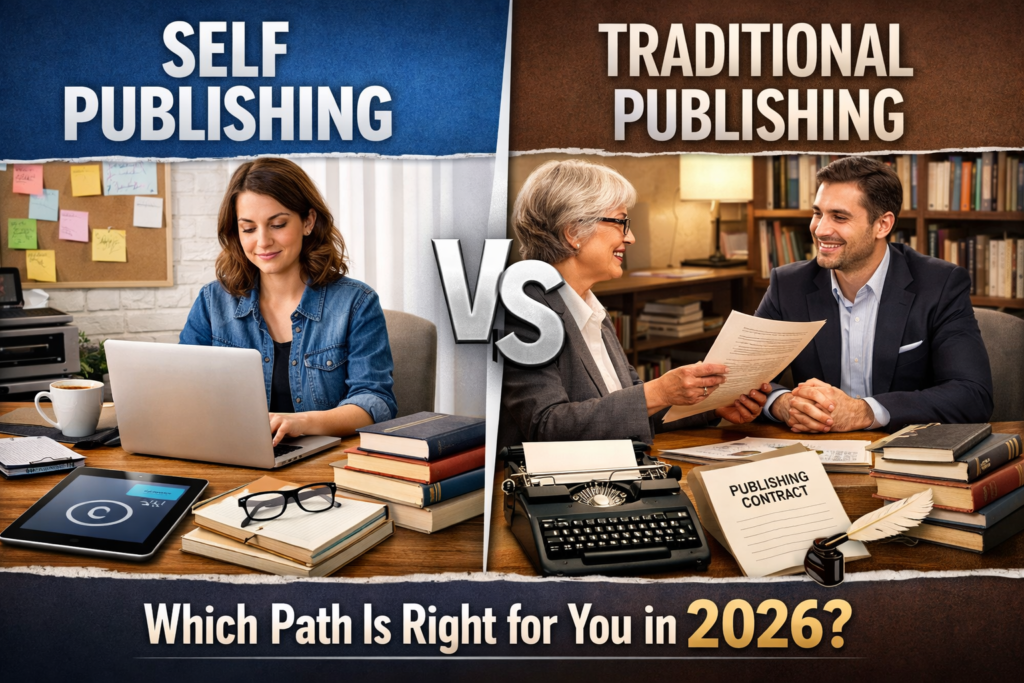
Publishing a book in 2026 has never offered more opportunities—or more confusion. With self-publishing platforms booming and traditional publishing still holding prestige, many authors find themselves asking the same question: Should I self-publish or pursue a traditional publishing deal?
Both paths can lead to success, but the right choice depends on your goals, budget, timeline, and creative vision. In this guide, we’ll break down self vs traditional publishing, explain how each works, and help you determine which option best fits your journey as an author.
What Is Traditional Publishing?
Traditional publishing involves submitting your manuscript to a publishing house, often through a literary agent. If accepted, the publisher handles editing, design, printing, and distribution.
Pros of Traditional Publishing
- No upfront publishing costs
- Professional editorial and design teams
- Wider bookstore distribution
- Industry credibility and recognition
Cons of Traditional Publishing
- Long submission and approval timelines
- Limited creative control
- Lower royalty rates
- No guaranteed marketing support
In 2026, traditional publishing remains competitive, with publishers accepting only a small percentage of submissions—often favoring established authors or market-driven manuscripts.
What Is Self Publishing?
Self-publishing allows authors to publish their books independently using platforms like Amazon Kindle Direct Publishing (KDP) and other global marketplaces.
Pros of Self Publishing
- Full creative control
- Faster time to market
- Higher royalty percentages
- Ownership of rights
Cons of Self Publishing
- Upfront investment required
- Full responsibility for quality and marketing
- Learning curve for new authors
Modern self-publishing in 2026 is highly professional, with many authors partnering with expert publishing service providers to ensure quality and visibility.
Key Differences: Self Publishing vs Traditional Publishing
Creative Control
Self-publishing gives authors complete authority over content, cover design, pricing, and updates. Traditional publishing often requires compromises.
Cost & Investment
Traditional publishing typically requires no upfront costs, while self-publishing involves expenses for editing, design, and marketing.
Royalties
Self-published authors can earn up to 70% royalties, compared to 5–15% in traditional publishing.
Time to Market
Self-publishing can take weeks or months. Traditional publishing may take years from submission to release.
Marketing Responsibility
Most traditional authors still handle much of their own marketing. Self-published authors must actively promote but have more flexibility and data access.
Which Publishing Path Is Right for You?
Self Publishing Is Ideal If You:
- Want creative freedom
- Prefer faster publication
- Aim to build a personal brand
- Write niche or evergreen content
Traditional Publishing Is Better If You:
- Seek bookstore placement
- Want industry validation
- Are comfortable with long timelines
- Have a market-driven manuscript
Many modern authors also adopt a hybrid approach, combining both methods across different projects.
How Professional Publishing Services Can Help
Regardless of the path you choose, professional support plays a vital role in success. From editing and cover design to Amazon publishing and book marketing, expert guidance ensures your book meets industry standards and reaches its intended audience.
At 24 Seven Publishing, authors receive end-to-end publishing solutions designed to remove confusion, reduce costly mistakes, and help books stand out in a crowded market.
Conclusion
There is no one-size-fits-all answer to the self-publishing vs traditional publishing debate. The best choice depends on your goals, resources, and long-term vision as an author.
What matters most is publishing professionally, strategically, and confidently—and choosing the path that empowers your story.
📌 Ready to publish your book in 2026?
Connect with 24 Seven Publishing and take the next step toward becoming a published author.
FAQs – Self Publishing vs Traditional Publishing
1. Is self-publishing worth it in 2026?
Yes. With improved platforms, global reach, and higher royalties, self-publishing remains a strong option for authors who prioritize control and speed.
2. Do traditional publishers still accept new authors?
Yes, but acceptance rates are low, and competition is high. A strong manuscript and agent representation are often required.
3. Which publishing method makes more money?
Self-publishing generally offers higher royalties, but success depends on quality, marketing, and consistency.
4. Can I self-publish and still look professional?
Absolutely. With professional editing, design, and formatting, self-published books can match or exceed traditional standards.
5. Can publishing services help with both options?
Yes. Professional publishing services support authors through self-publishing, traditional submissions, and hybrid publishing strategies.