
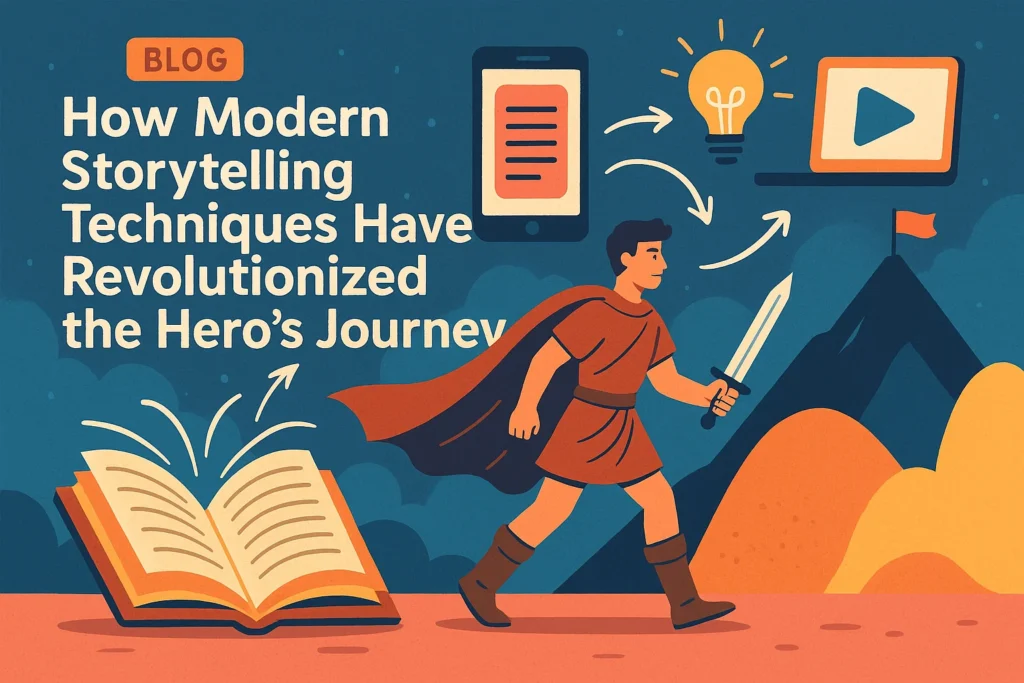
The Hero’s Journey, a narrative framework famously outlined by Joseph Campbell in The Hero with a Thousand Faces, has been the backbone of storytelling for millennia. From ancient myths to modern blockbusters, it’s been a crucial blueprint for writers seeking to craft compelling, emotionally resonant stories. However, as the landscape of storytelling evolves, so too has the Hero’s Journey. Modern storytelling techniques have breathed new life into this age-old structure, shifting its use to reflect contemporary sensibilities and pushing creative boundaries.
In this blog, we’ll explore how modern storytelling techniques have revolutionized the Hero’s Journey. We’ll look at the innovative ways writers today are adapting, subverting, and expanding upon Campbell’s original framework, introducing fresh perspectives, deeper characters, and more complex narratives. Additionally, we’ll examine the intersection of these techniques with digital platforms, social media, and a more diverse global audience.
The Hero’s Journey: A Quick Overview
Before diving into the ways modern storytelling techniques have transformed the Hero’s Journey, let’s briefly revisit its key stages. According to Joseph Campbell, the Hero’s Journey is a circular, twelve-stage journey that the protagonist typically undergoes. It involves:
- The Ordinary World – The hero’s everyday life before the adventure.
- Call to Adventure – A challenge or invitation to leave the ordinary world.
- Refusal of the Call – The hero hesitates or refuses the call for personal reasons.
- Meeting the Mentor – The hero meets a wise figure who guides them.
- Crossing the Threshold – The hero commits to the adventure, leaving their old life behind.
- Tests, Allies, and Enemies – The hero faces challenges and meets allies and foes.
- Approach to the Inmost Cave – The hero nears a pivotal confrontation.
- The Ordeal – A major crisis or confrontation.
- Reward (Seizing the Sword) – The hero achieves a hard-won reward.
- The Road Back – The hero faces a final challenge before returning home.
- Resurrection – The hero undergoes a transformation, often at a great cost.
- Return with the Elixir – The hero returns to the ordinary world, changed by the journey.
This structure, while not rigid, has served as the foundation for countless stories, from ancient myths to modern epics like Star Wars and The Lord of the Rings. But how have modern storytelling techniques reshaped this traditional structure?
1. Subverting the Hero’s Journey: Complexity in Character Development
One of the most significant modern shifts in the Hero’s Journey is the increasing complexity of the protagonist. Traditionally, heroes were often depicted as clear-cut figures—brave, noble, and virtuous. However, modern storytelling techniques have brought more nuanced characters to the forefront.
Antiheroes and Morally Complex Protagonists
In today’s storytelling landscape, antiheroes and morally complex protagonists have become staples. These characters may still go on journeys of self-discovery or transformation, but their motivations, actions, and relationships are far more ambiguous. Think of Walter White in Breaking Bad or Dexter Morgan in Dexter—characters who blur the lines between good and evil. These characters don’t neatly fit into Campbell’s heroic mold, which allows for richer, more unpredictable storytelling.
By embracing antiheroes, writers can subvert the traditional Hero’s Journey, presenting characters who don’t necessarily “return with the elixir” in a redemptive sense. Instead, they may return with a harder, more cynical view of the world or be left forever transformed, but not necessarily in a way that leads to clear-cut moral victory.
Example: Walter White in Breaking Bad
Walter White’s journey in Breaking Bad is a perfect example of a modern Hero’s Journey with an antihero twist. He begins as a simple, humble chemistry teacher, but his transformation into a ruthless drug kingpin makes his journey both compelling and morally ambiguous. Walter’s evolution challenges traditional heroic traits, and his eventual “return” is far from redemptive. Instead, it’s filled with tragedy, highlighting the flaws of traditional heroism and the complexities of human nature.
2. The Rise of Diverse Heroes and Multiple Perspectives
Another major revolution in modern storytelling is the inclusion of diverse protagonists. For years, the Hero’s Journey has been associated with a single, often male, white protagonist. Today, however, modern storytelling techniques emphasize diversity and inclusivity, allowing a broader range of voices to be heard.
Women Heroes and Non-Western Perspectives
Stories today are being told from the perspectives of women, people of color, LGBTQ+ individuals, and characters from non-Western cultures. This shift challenges the traditional Hero’s Journey by introducing different cultural understandings of heroism and transformation. For example, in Mulan, the protagonist’s journey to become a warrior doesn’t simply follow the traditional structure; it also explores themes of gender and cultural identity.
Similarly, stories from African, Asian, and Indigenous cultures reframe the Hero’s Journey by embedding it in different worldviews, philosophies, and mythologies. In this context, the journey may not necessarily involve a physical quest or heroic battle but could focus on spiritual growth, societal change, or collective healing.
Multiple Heroes and Collective Journeys
Modern storytelling also sees a rise in collective heroism, with multiple protagonists or ensemble casts. Movies like The Avengers and Game of Thrones feature a variety of heroes, each with their own individual arcs that contribute to a larger narrative. These stories use modern storytelling techniques to show how different characters’ journeys intersect, overlap, and influence each other in profound ways.
Example: The Avengers and Collective Heroism
The Avengers presents a team of heroes, each with their individual backstories and arcs. Rather than following a singular Hero’s Journey, the film shows how each character’s evolution impacts the team’s overall success. This collective heroism introduces a more complex narrative structure, where the strength of the group is more important than any single individual’s journey.
3. Nonlinear Narratives and Time Manipulation
Another storytelling revolution that has impacted the Hero’s Journey is the use of nonlinear timelines. Where once the journey was told in a straightforward, linear progression, many modern stories embrace flashbacks, parallel timelines, and time manipulation to deepen the narrative.
Nonlinear Structure
In movies like Pulp Fiction or shows like Westworld, the Hero’s Journey is not presented in chronological order. By weaving the hero’s past, present, and future together in a nonlinear fashion, these stories create suspense, mystery, and a more dynamic exploration of the hero’s transformation. This technique adds complexity to the journey by forcing the audience to piece together the narrative themselves, often revealing critical moments out of order to enhance the story’s emotional impact.
Time Loops and Parallel Universes
Another modern storytelling technique that affects the Hero’s Journey is the use of time loops or alternate realities. Stories like Doctor Strange or Groundhog Day explore the consequences of repeated cycles, where the hero must confront and overcome the same challenge repeatedly until they achieve personal growth or understanding. This can create an entirely new type of Hero’s Journey, one focused not on external victory but on internal transformation.
Example: Groundhog Day and the Time Loop Structure
Groundhog Day takes a familiar Hero’s Journey and adds the element of time manipulation. Bill Murray’s character, Phil Connors, is forced to relive the same day repeatedly, leading to an evolving internal transformation. This type of nonlinear narrative allows the hero to undergo profound growth, albeit in a nontraditional, non-linear structure.
4. Genre Blending and Hybrid Narratives
Modern storytelling techniques increasingly involve blending genres and hybrid narratives, resulting in innovative takes on the Hero’s Journey. By combining elements of sci-fi, fantasy, mystery, romance, and drama, writers can craft stories that break traditional genre boundaries.
Fantasy Meets Reality
In contemporary fiction, the Hero’s Journey doesn’t always take place in a fantastical realm. For instance, in The Hunger Games, the hero’s journey unfolds within a dystopian world that incorporates elements of survival, politics, and social commentary. Similarly, magical realism, seen in authors like Gabriel García Márquez, blends the mundane with the fantastical, adding layers of symbolic meaning to the Hero’s Journey.
Postmodern Deconstruction
Many modern stories also involve deconstructing the Hero’s Journey itself, turning it into a commentary on storytelling conventions. Movies like Scream or Deadpool play with the expectations of the audience, showing characters who are aware of their roles within a narrative structure. These stories challenge traditional storytelling and invite the audience to question the nature of heroism itself.
Example: Deadpool and the Postmodern Twist
Deadpool is a perfect example of a modern Hero’s Journey that subverts traditional expectations. The protagonist is fully aware of his role in a comic book narrative and actively breaks the fourth wall. The film’s self-referential humor and meta-commentary make it a unique deconstruction of the Hero’s Journey, allowing audiences to engage with the narrative in a more playful and reflective manner.
5. The Influence of Technology and Digital Platforms
The rise of digital platforms and new media has also influenced how the Hero’s Journey is told. In a world where content is constantly evolving through social media, YouTube, podcasts, and interactive platforms, the traditional Hero’s Journey is becoming more dynamic.
Interactive Storytelling
In the world of video games, the Hero’s Journey often becomes interactive, where players take on the role of the protagonist, making choices that shape the story’s outcome. Games like The Witcher 3 and Mass Effect allow players to determine the course of the hero’s journey, adding layers of complexity to traditional narrative structures.
Social Media and Viral Narratives
Social media also plays a role in shaping modern hero stories. Individuals can go on personal journeys that are documented in real time, with followers engaging in the narrative. This creates a sense of collective heroism, where the audience participates in the journey rather than passively consuming it.
Example: Interactive Storytelling in Mass Effect
In Mass Effect, players navigate a personalized Hero’s Journey, where their choices influence the narrative’s direction. This interactivity creates a deeper emotional connection to the hero’s evolution, as the player is actively shaping the journey instead of simply following a prescribed plotline.
Frequently Asked Questions (FAQ)
Q1: How has the Hero’s Journey evolved in modern storytelling?
Modern storytelling techniques have introduced more complex, diverse, and morally ambiguous characters, while nonlinear narratives and genre blending have expanded the boundaries of the traditional Hero’s Journey.
Q2: What are some examples of modern stories that subvert the Hero’s Journey?
Examples include Breaking Bad, which follows a morally ambiguous character, and The Hunger Games, which reimagines the Hero’s Journey within a dystopian context.
Q3: How do nonlinear narratives affect the Hero’s Journey?
Nonlinear narratives, such as in Pulp Fiction and Westworld, create suspense and allow the audience to uncover the hero’s journey in a non-chronological order, enhancing the emotional impact of the story.
Q4: What role does diversity play in the modern Hero’s Journey?
Diversity has expanded the scope of the Hero’s Journey by allowing stories from different cultures, genders, and perspectives to emerge, creating more inclusive narratives that resonate with a global audience.
Q5: How does technology influence the Hero’s Journey today?
Technology has introduced interactive storytelling, particularly in video games, where players make choices that affect the hero’s journey, and on social media, where real-time personal journeys are shared with followers.
Conclusion
The evolution of modern storytelling techniques has revolutionized the Hero’s Journey, making it more complex, diverse, and interactive. Writers and creators now have the freedom to explore new forms of narrative, from nonlinear timelines to multi-perspective narratives, and from antiheroes to ensemble casts. These changes not only breathe new life into the Hero’s Journey but also make it relevant in today’s ever-evolving world.
As a writer or content creator, embracing these modern storytelling techniques can open up new avenues for creativity and engagement. If you’re looking for guidance on your next storytelling project, 24 Seven Publishing offers a range of services to help bring your vision to life.